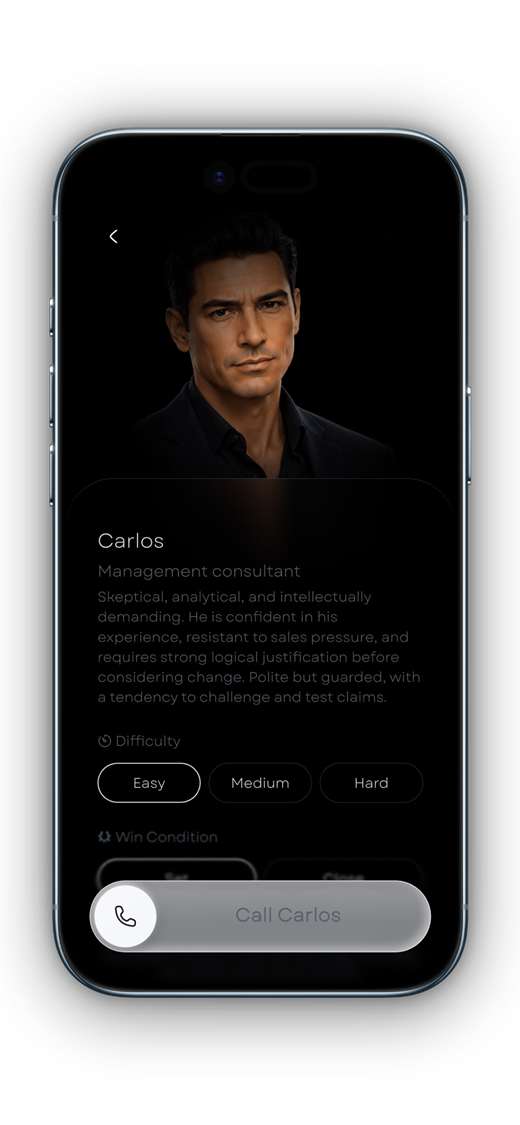
Cold calling
Cold Calling Scripts: A Flexible Framework for Real Conversations
The short answer: The best cold calling script is a decision tree, not a monologue. It gives you a clear opener, two or three discovery questions, concise responses to predictable objections, and a direct next-step ask while leaving room to listen.
Scripts fail when reps try to recite them and succeed when reps use them as rails. The goal is to reduce decision load under pressure while preserving a natural response to what the buyer actually says.
Pair this guide with How to Practice Cold Calls Before You Dial Real Prospects, then use the practice plan below to rehearse.
A five-part cold call script framework
Build the script around five moments: opening, reason for the call, current-state question, problem exploration, and next step. Write one or two strong options for each moment. On the call, choose the line that fits rather than marching through every line in order.
A compact framework might sound like this: “I noticed X, and we often see Y when that happens. How are you handling it today?” If the buyer confirms friction, ask for an example and its impact. If there is a fit, summarize the problem and propose one clear next step.
- Open: identify yourself and earn 30 seconds.
- Orient: connect the call to a relevant trigger or problem.
- Explore: ask how the buyer handles it now.
- Deepen: understand consequence, priority, and ownership.
- Advance: ask for a specific meeting or action.
A B2B cold call script example
“Hi Priya, this is Sam with Northstar. I noticed your customer team has doubled this year. We help support leaders reduce the training time that usually comes with that kind of growth. Mind if I ask how you are onboarding the new group today?” This example works because the observation leads naturally to a question.
If Priya says the team already has a process, the script branches: “Makes sense. What does the ramp period look like right now?” If she says it is not a priority, another branch opens: “Understood. What is taking priority instead?” You are still following a structure, but the prospect's answer controls the route.
Write branches for the first objections
Most cold calls do not fail because a rep lacks a clever rebuttal. They fail because the first objection creates panic. Write a short acknowledge-and-question branch for the objections you hear most: “not interested,” “send information,” “we already use someone,” and “no budget.”
The response should not try to defeat the buyer. Acknowledge the concern, reduce pressure, and ask a diagnostic question. For example: “Happy to send something. So I make it relevant, which part of your current process is most frustrating?” The question turns a brush-off into useful context without ignoring the request.
Personalize the reason, not every word
Personalization matters most in the bridge between identity and discovery. A role change, hiring plan, product launch, regulatory shift, or public priority can make the call timely. You do not need a paragraph about the prospect's podcast appearance unless it connects directly to the problem you solve.
Keep the rest of the script stable long enough to learn from it. If every call uses entirely different wording, you cannot tell whether the opener, list, offer, or delivery changed the result. Controlled repetition produces better judgment than constant improvisation.
Practice plan
Turn one script into a conversation map
Take your current script and rewrite it on one page so every statement leads to a likely buyer response.
- Circle every question and remove any that does not change your next move.
- Cut the company introduction to one sentence.
- Add branches for the four objections you hear most.
- Rehearse each branch until you can answer without looking down.
- Run one full call with an AI prospect and revise the line where you lost momentum.
Frequently asked questions
Do cold calling scripts still work?
Yes, when used as flexible conversation maps. A rigid monologue sounds scripted; a structured set of openers, questions, objection branches, and next steps reduces hesitation while leaving room to listen.
How should a beginner write a cold call script?
Start with one target customer, one problem, three discovery questions, and one next-step ask. Add objection branches only after you hear them in practice or real calls.
Should I memorize my cold call script?
Memorize the purpose and a few anchor lines, not every word. You should be able to look away from the page and respond to the buyer's actual language.
Turn the idea into a reflex
Read less. Rehearse more.
Put one idea from this guide into a spoken practice call. Salesy: AI Sales Roleplay brings lessons, AI voice prospects and post-call feedback to iPhone and iPad. Choose an available scenario and work on your next response.
Get Salesy on the App StoreFree to download. In-app purchases available.