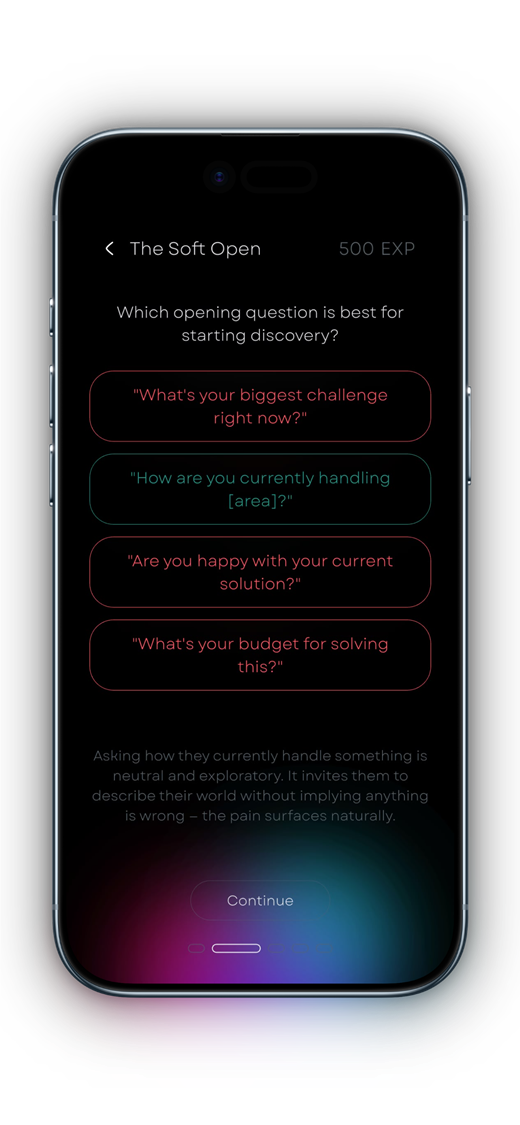
Discovery
Discovery Call Roleplay Scenarios for Better Follow-Up Questions
The short answer: Good discovery roleplay scenarios contain a visible symptom, a deeper cause, a meaningful consequence, and information the buyer reveals only after relevant questions. The rep succeeds by understanding and summarizing the situation, not by mentioning every feature.
Discovery practice needs ambiguity. If the buyer hands over the whole problem after one question, the rep never learns to listen for vague language, ask for evidence, or recognize when there is no reason to change.
Pair this guide with Discovery Call Roleplay: A Practical Scenario and Review Guide, then use the practice plan below to rehearse.
Use scenarios with different kinds of uncertainty
In the vague-pain scenario, the buyer says reporting is “a mess” but has not described the process. In the satisfied-buyer scenario, the current solution works and only one small limitation exists. In the low-priority scenario, the problem is real but another initiative matters more.
A stakeholder scenario can give the user and finance different definitions of success. An incomplete-information scenario requires the rep to identify who knows the missing facts. A no-fit scenario tests whether the rep can end discovery honestly.
Write the buyer brief so answers stay consistent
Give the buyer a current process, trigger, desired outcome, private concern, stakeholders, and boundary. Mark which facts they volunteer and which require a thoughtful follow-up. Avoid requiring an exact phrase from the rep before releasing information.
The buyer should respond to the quality and relevance of the question. Broad questions get broad answers. Specific, neutral follow-ups get examples. Leading questions can create resistance or correction.
Score understanding before persuasion
Review whether the rep learned the current process, found a concrete example, explored impact without exaggeration, checked priority, and understood the decision. Ask the rep to summarize the case in the buyer's language.
Only then review how the rep connected a possible solution. If the scenario had no strong reason to change, the correct outcome may be a future follow-up or a clean disqualification.
Practice plan
Run the hidden-cause discovery scenario
The buyer will mention a symptom but protect the deeper cause until the rep earns it.
- Give the buyer a process, symptom, hidden cause, and consequence.
- Let the rep open and ask current-state questions.
- Reveal the cause only after a relevant example question.
- Stop after the rep summarizes and suggests a next step.
- Debrief the question that changed the conversation, then replay it.
Frequently asked questions
What should I practice in a discovery roleplay?
Practice current-state questions, follow-ups based on answers, examples, impact, priority, stakeholder understanding, summaries, and honest qualification.
How long should a discovery roleplay be?
A focused question drill can take five minutes. A fuller discovery simulation may take 15 to 30 minutes, depending on complexity.
Can the buyer invent details during roleplay?
The buyer can respond naturally within the brief, but major facts should stay consistent so the rep is practicing discovery rather than guessing what changed.
Turn the idea into a reflex
Read less. Rehearse more.
Put one idea from this guide into a spoken practice call. Salesy: AI Sales Roleplay brings lessons, AI voice prospects and post-call feedback to iPhone and iPad. Choose an available scenario and work on your next response.
Get Salesy on the App StoreFree to download. In-app purchases available.