Discovery
Sales Discovery Questions That Reveal a Reason to Change
The short answer: The best sales discovery questions move from facts to consequences: how the buyer works today, where the process breaks, what the problem costs, why it matters now, and how a decision would be made. Follow-up questions matter more than a long checklist.
Discovery is not a questionnaire. It is a shared investigation into whether change is worth the effort. Your questions should help the buyer think more clearly, while giving you enough evidence to decide whether your solution belongs in the conversation.
Pair this guide with A Discovery Call Framework That Keeps the Buyer Talking, then use the practice plan below to rehearse.
Start with the current state
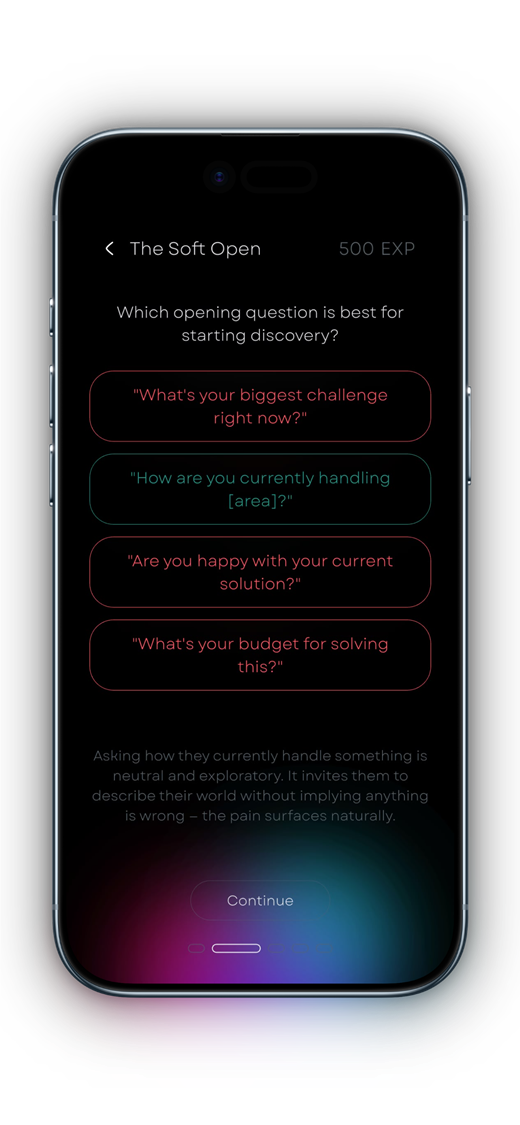
Ask the buyer to walk you through what happens today. “How does a lead move from first response to qualification?” produces a process you can inspect. “Are you happy with your process?” produces a polite opinion that is hard to explore.
Current-state questions should uncover tools, people, handoffs, volume, timing, and workarounds. Listen for friction the buyer treats as normal. A manual spreadsheet or repeated follow-up may be the visible clue to a larger operational cost.
- Walk me through how you handle this today.
- Where does the process slow down or break most often?
- Who is involved when that happens?
- What have you already tried to improve it?
Move from the problem to its impact
A problem without impact rarely creates action. Ask what the issue changes for revenue, time, risk, customers, or the buyer personally. Avoid forcing dramatic answers. “What happens when that delay reaches the customer?” is cleaner than “That must be costing you millions, right?”
Quantification helps when the buyer has the numbers, but a defensible range is better than false precision. You can ask how often the issue appears, how many people touch it, and what a normal delay looks like. Together, those answers build a credible picture of consequence.
Understand urgency without manufacturing it
Ask what changed, what has a deadline, and what competes for attention. “Why look at this now?” can reveal a leadership mandate, growth target, renewal date, or no urgency at all. A “no urgency” answer is useful because it tells you not to fake a close.
Explore the cost of staying the same and the conditions that would make action sensible. The buyer should feel free to conclude that the problem is not large enough. That freedom makes the rest of the conversation more credible.
Map the decision before proposing the next step
Good discovery includes the path to a decision: who cares about the outcome, who owns budget, what evidence is required, and what could stop the project. Ask this as practical planning, not an interrogation about authority.
Finish by summarizing what you heard in the buyer's language. Ask them to correct it. If the summary is accurate and the problem is meaningful, the next step should follow logically: a technical review, a second conversation, a trial, or a clear decision not to proceed.
Practice plan
Practice the five-layer question ladder
Use one realistic buyer problem and move through five layers without pitching.
- Current state: ask how the work happens today.
- Friction: ask where it becomes difficult.
- Impact: ask what that difficulty changes.
- Priority: ask why it matters now.
- Decision: ask what a sensible evaluation would involve.
- Summarize the full chain in two sentences.
Frequently asked questions
How many discovery questions should I ask?
Use as many as the conversation needs, not a fixed quota. A focused call may use five strong questions with follow-ups; a complex sale may require more across several conversations.
What is the most important discovery question?
“Walk me through how you handle this today” is a strong starting point because it reveals the process and creates several natural follow-up paths.
When should I talk about the product?
After you can summarize the buyer's situation, impact, and desired change accurately. Then connect only the relevant capabilities to what the buyer said.
Turn the idea into a reflex
Read less. Rehearse more.
Put one idea from this guide into a spoken practice call. Salesy: AI Sales Roleplay brings lessons, AI voice prospects and post-call feedback to iPhone and iPad. Choose an available scenario and work on your next response.
Get Salesy on the App StoreFree to download. In-app purchases available.