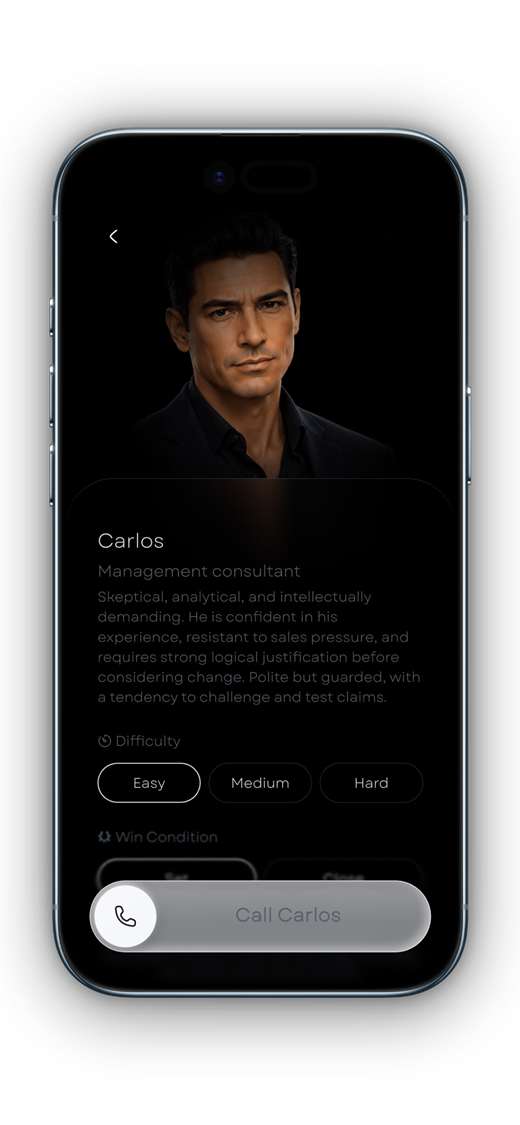
Sales practice
How to Practice a Sales Pitch Until It Sounds Natural
The short answer: Practice a sales pitch in short sections, explain the value in several lengths, invite realistic interruptions, and repeat the weakest transition immediately. Memorize the message and proof-not a theatrical word-for-word performance.
A pitch sounds natural when you can adapt it without losing the central idea. That requires more than repetition from the first slide to the last. You need compression, interruption, and recovery.
Pair this guide with Sales Training for Beginners: The Skills to Learn First, then use the practice plan below to rehearse.
Define the one idea the buyer should remember
Write the buyer, problem, change, and evidence in four lines. If those lines are unclear, practicing delivery will only make the confusion more fluent. The pitch should connect a specific audience to a meaningful outcome through a believable mechanism.
Remove claims that could belong to any product. “Save time and grow revenue” says little. Name the workflow that changes and the evidence the buyer would use to judge it.
Practice the pitch at three lengths
Deliver the core message in 30 seconds, two minutes, and five minutes. The short version tests clarity. The medium version adds the problem and proof. The longer version allows context, examples, and a next step.
Compression reveals what matters. If you cannot explain the value without a slide deck, the message may depend too heavily on features or internal language.
Rehearse interruption and recovery
Ask a roleplay partner or AI prospect to interrupt with questions, skepticism, and requests to skip ahead. Practice answering briefly, checking whether the answer was enough, and returning to the correct place without apologizing for the interruption.
A real pitch is a conversation with a prepared spine. Interruptions are evidence of engagement when handled well. Your goal is not to protect the sequence; it is to protect understanding.
Review the transitions, not just the words
Notice where the pitch shifts from problem to product, product to proof, and proof to next step. Weak transitions create the feeling of a deck being read at the buyer. Strong transitions connect directly to what the buyer has said.
Use feedback on observable moments: the value took too long to arrive, the example lacked a result, the answer ran for two minutes, or the next step was vague. Repeat the exact moment after each note.
Practice plan
Run the compression ladder
Use the same sales message at three lengths, then pressure-test the middle version.
- Give the 30-second version with no slides.
- Give the two-minute version with one example.
- Give the five-minute version with a buyer question in the middle.
- Repeat the weakest transition three times.
- End every version with one relevant question.
Frequently asked questions
How many times should I practice a sales pitch?
Practice until you can deliver the core message at different lengths and recover from interruptions without losing clarity. Focused repeats of weak moments are more useful than counting full run-throughs.
Should I memorize my sales pitch?
Memorize the structure, key evidence, and a few anchor sentences. Leave the exact wording flexible enough to respond to the buyer.
How do I get feedback on a sales pitch?
Record it, use a colleague or AI roleplay partner, and ask for specific feedback on clarity, relevance, pace, proof, and the next-step ask.
Turn the idea into a reflex
Read less. Rehearse more.
Put one idea from this guide into a spoken practice call. Salesy: AI Sales Roleplay brings lessons, AI voice prospects and post-call feedback to iPhone and iPad. Choose an available scenario and work on your next response.
Get Salesy on the App StoreFree to download. In-app purchases available.