Sales practice
Sales Roleplay: How to Practice, Run and Improve a Call
The short answer: Sales roleplay is a structured rehearsal in which one person sells and a peer, manager, or AI plays the buyer. A useful roleplay defines the buyer, call stage, pressure point, and behavior to practice. Run a short attempt, review observable evidence, choose one change, and replay the pivotal moment.
Sales roleplay is most useful when it feels like practice, not theater. The goal is not to deliver a flawless performance for an audience. It is to expose one difficult moment, make the response visible, and give the seller another attempt while the feedback is still fresh.
Pair this guide with Sales Roleplay Script Template: Build the Buyer, Not a Speech, then use the practice plan below to rehearse.
What sales roleplay is and when to use it
Use roleplay before a conversation matters: a first cold call, a discovery meeting, a product change, a pricing discussion, or a sales interview. It can also follow call review when the same behavior appears more than once, such as pitching before understanding the problem or ending without a clear next step.
Roleplay is not a substitute for product knowledge. Teach facts, rules, and approved claims first. Then rehearse how to use that knowledge when a buyer interrupts, disagrees, asks a follow-up, or introduces a constraint that changes the conversation.
Build the buyer before you start
A useful brief names the buyer's role, current situation, reason for taking the call, private concerns, and decision boundary. Give the seller only what they would reasonably know. Give the buyer enough private information to reward relevant questions instead of volunteering every useful fact.
Set one pressure point and one target behavior. For example, the buyer likes the idea but worries about implementation time, while the seller must ask for a recent example before explaining the product. That is easier to practice and review than a vague instruction to sell the solution.
- One buyer with a believable reason to engage.
- One call stage and a clear starting point.
- One concern the buyer will not reveal immediately.
- One observable seller behavior to review.
Run a short attempt, feedback and replay loop
Keep the first attempt short enough to repeat. Four to seven minutes is often enough for a cold-call opening, discovery segment, objection, or next-step conversation. The buyer should stay inside the brief and respond to what the seller actually says rather than steering toward a predetermined win.
After the attempt, let the seller reflect first. The buyer then explains how specific words or timing affected the conversation. Add one observer note tied to the target behavior, choose one change, and replay the difficult exchange immediately.
Choose a peer, manager, or AI buyer
Peers make quick practice accessible and let reps experience both sides of a call. Managers add account context and judgment. AI roleplay can provide private repetition and a consistent scenario without requiring another person's calendar. Each format solves a different constraint.
Use the option that fits the goal. A manager may be best for a strategic negotiation, a peer for a weekly team drill, and an AI sales roleplay for repeated objection practice. A blended routine can use all three.
Score behavior and check transfer
A simple scorecard should describe what could be heard: the seller stated a relevant reason for the call, asked a follow-up based on the answer, acknowledged the concern, explained only what was relevant, and agreed an appropriate next step. Support each judgment with a quote or moment.
A better second attempt shows learning inside the exercise. It does not prove the skill will transfer to real work. Review later calls for the same behavior and adjust the scenario if the practice buyer was too easy, too difficult, or unlike the people the seller actually meets.
Avoid the mistakes that make roleplay feel fake
Do not ask a colleague to improvise a generic difficult customer. Do not score personality, confidence, or charisma without defining the behavior behind those labels. Do not let feedback expand into ten unrelated coaching points that leave no time for another attempt.
Keep difficulty stable between the first attempt and replay. If the buyer changes the hidden facts or becomes suddenly cooperative, the seller cannot tell whether the new response helped. Use the sales roleplay script template to make the setup repeatable.
Practice plan
Run one complete sales roleplay
Practice a single difficult moment from a conversation you expect this week.
- Write the buyer brief, private concern, and decision boundary.
- Give the seller one outcome and one behavior to practice.
- Run a five-minute attempt without pausing to coach.
- Use self-review, buyer impact, and one evidence-based note.
- Replay the pivotal exchange with one deliberate change.
Frequently asked questions
What is sales roleplay?
Sales roleplay is a structured practice conversation in which a seller rehearses with a peer, manager, coach, or AI acting as the buyer.
How long should a sales roleplay be?
Use the shortest round that contains the target behavior. Many focused drills fit into four to seven minutes, followed by feedback and an immediate replay.
Does sales roleplay work?
It can improve a specific behavior when the scenario is realistic, feedback is observable, and the seller repeats the moment. Check real calls to see whether the behavior transfers.
Turn the idea into a reflex
Read less. Rehearse more.
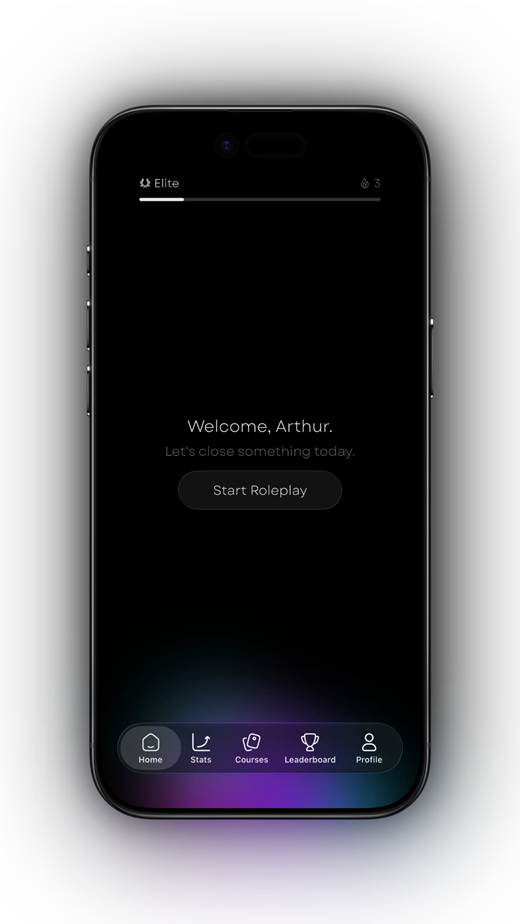
Put one idea from this guide into a spoken practice call. Salesy: AI Sales Roleplay brings lessons, AI voice prospects and post-call feedback to iPhone and iPad. Choose an available scenario and work on your next response.
Get Salesy on the App StoreFree to download. In-app purchases available.