Sales coaching
Sales Simulation Training: Design Practice That Transfers
The short answer: Sales simulation training recreates a buyer conversation so a rep can practice decisions and language before a live call. Effective simulations define the buyer, stage, stakes, hidden information, difficulty, target behavior, scorecard, and replay. Progress from simple moments to integrated calls and verify transfer in real work.
A simulation should reproduce the decision the rep needs to make, not every detail of a real account. When the setup is focused, the seller can attempt the behavior, see its effect, receive evidence, and try the moment again without risking a buyer relationship.
Pair this guide with Sales Coaching Software: Choose the Workflow, Not the Dashboard, then use the practice plan below to rehearse.
Choose the decision the simulation will expose
Start with evidence from calls, onboarding, product changes, or manager observation. Define what the rep must notice and do, such as asking for an example after a vague problem, distinguishing price from budget, or involving another stakeholder without undermining the current contact.
Avoid using a full sales cycle when the gap occurs in one exchange. A smaller simulation reduces noise and makes the effect of feedback easier to see. Use an integrated call later to test whether the behavior holds alongside other demands.
Build functional realism, not decorative detail
Realism comes from believable motives, incomplete information, consequences, and boundaries. A buyer should have a reason to engage, a reason to resist, and facts that emerge only when the seller asks relevant questions. Industry names and elaborate backstories do not compensate for weak behavior rules.
Choose a peer, manager, trained actor, branching exercise, or AI buyer based on the decision being practiced. Voice matters when the skill involves pacing and live response. Written simulation can still help with question choice, structure, and reasoning.
Increase difficulty one dimension at a time
Begin with a clear buyer and one concern. Later add time pressure, ambiguity, interruption, competing priorities, multiple stakeholders, or a change in direction. If every challenge appears at once, feedback becomes broad and the rep may only learn that the exercise felt hard.
Keep the scenario stable for an immediate replay. Across later sessions, vary the buyer while preserving the target skill. This tests whether the rep learned a principle rather than memorized one response.
Score observable behavior with evidence
Use criteria that an observer can identify in the transcript or recording. For discovery, score whether the rep asked for a concrete example, explored impact, followed the answer, and summarized accurately. For objections, score acknowledgment, clarification, response relevance, and the appropriateness of the next step.
A numerical score can summarize evidence but should not replace it. Calibrate reviewers with sample calls, discuss ambiguous cases, and avoid using an automated score as the sole basis for a consequential employment decision.
Connect the simulation to a learning sequence
Use a short explanation, a worked example, the first attempt, feedback, an immediate replay, spaced practice, and application to a live conversation. Managers should reference the same behavior in later call review so reps see one coherent standard.
Track participation, change across comparable simulations, transfer to relevant calls, and business outcomes separately. A strong simulated call is evidence of performance in that exercise, not a guarantee of a sale.
Select a simulator after designing the exercise
A sales call simulator can make practice easier to repeat, while human or AI sales roleplay provides different kinds of interaction and feedback. Evaluate whether the chosen format supports the buyer rules, voice behavior, evidence, accessibility, and replay you designed.
Use fictional information during general practice. If scenarios draw on real customers, calls, employees, or company material, follow the relevant privacy, security, consent, and approval processes.
Practice plan
Design a three-level sales simulation
Build difficulty gradually around one behavior you can hear and review.
- Define the buyer decision and one target seller behavior.
- Create level one with a clear context and one concern.
- Add one source of ambiguity or pressure for level two.
- Use level three to integrate the skill into a fuller call.
- Score evidence, replay each level, and check a later real call for transfer.
Frequently asked questions
What is sales simulation training?
It is practice that recreates a sales conversation or decision so a rep can attempt, review, and repeat behavior before or between real buyer interactions.
How is a sales simulation different from roleplay?
Roleplay is a common simulation format. Simulations may also use branching choices, written cases, recorded responses, avatars, or other structured exercises.
How do you measure a sales simulation?
Measure observable behavior inside comparable attempts, then look for the same behavior in relevant real calls. Track business outcomes separately and consider other influences.
Turn the idea into a reflex
Read less. Rehearse more.
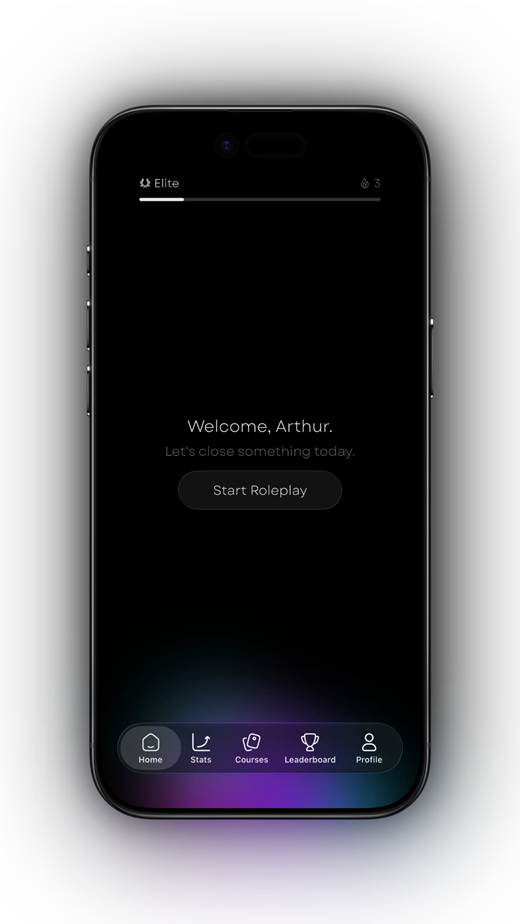
Put one idea from this guide into a spoken practice call. Salesy: AI Sales Roleplay brings lessons, AI voice prospects and post-call feedback to iPhone and iPad. Choose an available scenario and work on your next response.
Get Salesy on the App StoreFree to download. In-app purchases available.