Sales coaching
Account Executive Training: Practice the Decisions Between Calls
The short answer: Account executive training should combine conversation practice with deal judgment: discovery, stakeholder alignment, relevant demos, business cases, technical handoffs, commercial negotiation, next steps, and honest qualification. Use real opportunity patterns without exposing unnecessary confidential information.
Account executives need more than polished calls. They must decide what the opportunity requires, who needs to be involved, which evidence matters, and whether continued effort is justified.
Pair this guide with Sales Manager Coaching Plan: One Behavior at a Time, then use the practice plan below to rehearse.
Train the full decision, not isolated lines
A roleplay can start with discovery and pause after each major decision: deepen the problem, involve another stakeholder, show a relevant product moment, validate a requirement, or disqualify. Ask the rep to explain the evidence behind the choice.
Use several acceptable outcomes. A strong rep may propose a technical review, return to discovery, narrow the scope, or stop the process. One rigid path rewards memorization over judgment.
Turn opportunity patterns into safe practice
Build fictional scenarios from recurring patterns: weak champion access, unclear impact, a late security concern, procurement pressure, a missing decision owner, or low adoption before renewal. Remove customer identifiers and sensitive details.
Practice the conversation and the internal plan. The rep should summarize known facts, gaps, risks, next actions, and exit criteria. Managers can coach both communication and resource allocation.
Connect roleplay with real call review
Review authorized call evidence to find a moment worth practicing. Recreate the buyer's line and context, then run several alternative responses. The goal is not to rewrite history; it is to prepare for the pattern's next appearance.
Track whether the target behavior changes in comparable calls. Revenue outcomes remain important, but they are too dependent on deal mix and market context to serve as the only training signal.
Practice plan
Run the AE decision room
Practice both the buyer conversation and the opportunity decision.
- Give the rep a fictional opportunity brief with known facts and gaps.
- Run a stakeholder conversation for ten minutes.
- Pause and ask what changed in the opportunity view.
- Choose the next stakeholder or evaluation action.
- State the risk, evidence needed, and condition for continuing.
Frequently asked questions
What should account executive training cover?
Cover discovery, qualification, stakeholders, demos, business cases, technical evaluation, negotiation, next steps, opportunity strategy, and call review.
How is AE training different from SDR training?
AE training usually includes deeper discovery, multiple stakeholders, evaluation, commercial decisions, and opportunity strategy, while SDR training often emphasizes starting and qualifying conversations.
Can AI roleplay help account executives?
Yes, especially for conversation repetition and stakeholder scenarios. Managers and specialists remain important for deal context, product accuracy, and strategy.
Turn the idea into a reflex
Read less. Rehearse more.
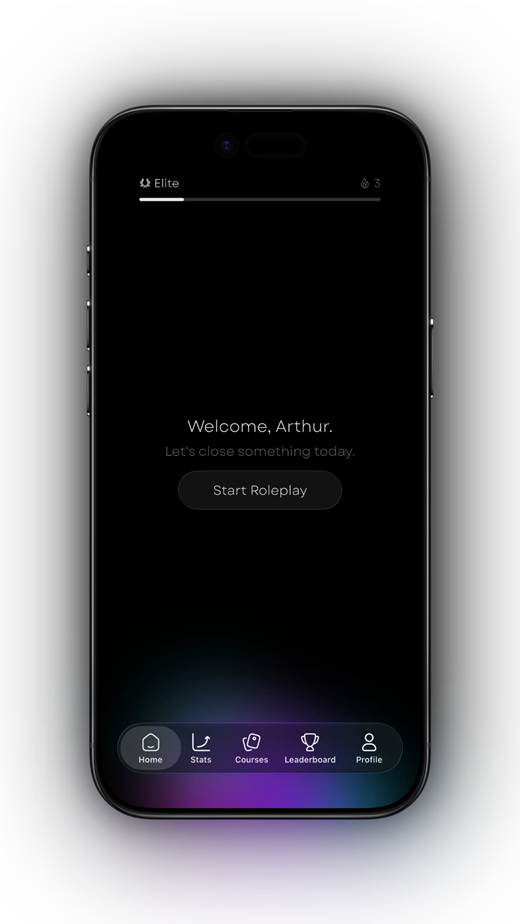
Put one idea from this guide into a spoken practice call. Salesy: AI Sales Roleplay brings lessons, AI voice prospects and post-call feedback to iPhone and iPad. Choose an available scenario and work on your next response.
Get Salesy on the App StoreFree to download. In-app purchases available.