Discovery
A Discovery Call Framework That Keeps the Buyer Talking
The short answer: A useful discovery call framework has six stages: align on the agenda, understand the current process, find friction, explore impact, define the desired change, and agree on a next step. The framework provides direction while the buyer's answers determine the depth.
A discovery call should feel organized without feeling processed. The buyer needs enough structure to trust the conversation and enough space to explain what is actually happening.
Pair this guide with Sales Qualification Questions for Real Opportunities, then use the practice plan below to rehearse.
1. Align on purpose and time
Open by confirming the time available and what each side wants from the conversation. A simple agenda reduces uncertainty: understand the current situation, decide whether there is a meaningful fit, and choose a next step only if one makes sense.
Invite the buyer to add to the agenda. This surfaces hidden expectations early and changes the call from a presentation into a joint working session.
2. Diagnose the current process and friction
Ask for the story of the process before asking for opinions about it. Sequence matters: what happens first, who acts next, where information moves, and what breaks. Concrete events are easier to analyze than broad claims like “efficiency is a challenge.”
When friction appears, stay there. Ask for the last example, what caused it, and who felt the effect. The fastest way to ruin discovery is to hear a keyword that matches your product and immediately begin pitching.
3. Connect the problem to impact and priority
Explore practical impact before emotional impact. Time, missed revenue, customer complaints, rework, and risk give the problem shape. Then ask what that means for the people responsible. Both layers matter: organizations approve projects, but people carry them.
Priority comes from comparison. Ask what else is competing for resources and what happens if nothing changes this quarter. If another initiative matters more, learn that now rather than after weeks of follow-up.
4. Define success and earn the next step
Ask what a better state would look like in observable terms. The answer may be a shorter ramp time, fewer manual handoffs, more consistent conversion, or a calmer team. Avoid promising an outcome before you understand how it would be measured.
Close by summarizing the current state, consequence, and desired change. Then recommend the smallest next step that resolves the biggest remaining uncertainty. A useful next step has a purpose, participants, and date-not a vague promise to reconnect.
Practice plan
Rehearse a 15-minute discovery call
Compressing the framework forces you to make every transition earn its place.
- Spend one minute aligning on agenda and time.
- Use four minutes to map the current process.
- Use four minutes to explore friction and impact.
- Use three minutes to understand priority and desired change.
- Use three minutes to summarize and agree on a next step.
- Review where you talked when a follow-up question would have worked better.
Frequently asked questions
How long should a discovery call be?
Simple sales can be diagnosed in 20–30 minutes; complex sales may need 45–60 minutes or several conversations. Use the shortest time that produces a reliable shared understanding.
Should I send an agenda before a discovery call?
Yes, especially for scheduled meetings. A short agenda helps the buyer prepare and makes it easier to include the right participants.
How do I end a discovery call?
Summarize what you heard, ask for corrections, state whether you see a fit, and propose a specific next step with a purpose and date.
Turn the idea into a reflex
Read less. Rehearse more.
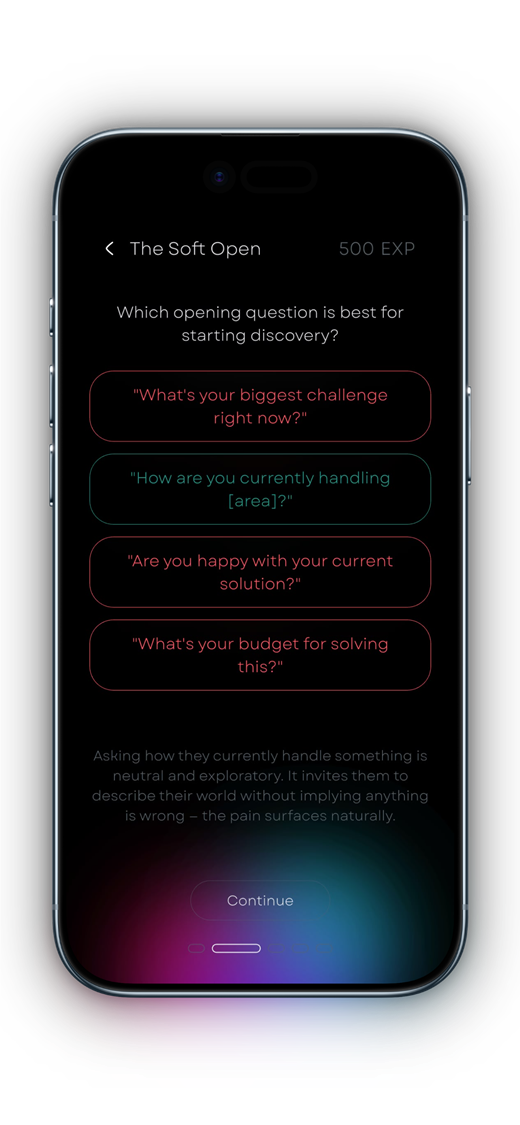
Put one idea from this guide into a spoken practice call. Salesy: AI Sales Roleplay brings lessons, AI voice prospects and post-call feedback to iPhone and iPad. Choose an available scenario and work on your next response.
Get Salesy on the App StoreFree to download. In-app purchases available.